Town


Town typically refers to a structure on an Adventure Map, where heroes can recruit troops, replenish their spell points, and learn new spells. More generally, it can refer to one of the nine different town types, that can be seen in the table on the right. In The Restoration of Erathia, there were only eight different town types, but Armageddon's Blade expansion added Conflux. Moreover, unofficial Horn of the Abyss expansion added Cove, Factory and Bulwark. Every player must own at least one town, so as to remain in contention for any amount of time until winning or losing the scenario. If a player loses the control of his last town, or if a player starts with no towns, he has time for seven days to conquer at least one town, otherwise being eliminated from the game. A map without towns is therefore largely undesirable, though not fully unplayable.
Towns are also important source of gold with hall buildings producing it every day for the kingdom. If a town has a marketplace, a player may trade surplus resources for needed ones, and Resource Silo produces resources daily (but not gold). Towns have horde buildings which increase units' growth. Buildings unique to each of the town types can provide additional strengths and abilities for heroes and units, produce resources, or support the gameplay on the adventure map.
Town with fort, citadel or castle have walls surrounding them, and can be defended by heroes in a siege battle. Other town defending structures that come with the fortifications are arrow towers and moat. Heroes can be located inside the town and inside the walls to protect the town. If a non-fortified town is sieged, a traditional battlefield is shown, as if the combat were not in a town.
Each town has its own musical theme. Nine common towns have themes written by Paul Romero, while music for HotA's Cove is written by Docent Picolan and HotA's Factory was written by Docent Picolan and Maigret.
Maximum number of towns is 48 on any map.
Neutral Town Garrison[edit | edit source]
Starting garrison of a town[edit | edit source]
Unless town garrison was defined on map, all towns not owned by a player makes four separate rolls, one for each of levels 1–4. Each roll that succeeds adds one stack of that town's basic (non-upgraded) creature:
| Level | Chance | Stack size |
|---|---|---|
| 1 | 33% | 8–15 |
| 2 | 33% | 5–7 |
| 3 | 20% | 3–5 |
| 4 | 13% | 1–3 |
So a default neutral town never starts with level 5–7 creatures or upgraded creatures. It can also start with no army at all, which happens about 30% of the time.
Weekly reinforcement of neutral town garrisons[edit | edit source]
At the start of every new week, each neutral town may get extra troops:
- A town with a Fort, Citadel or Castle: 80% chance.
- A town with no fort: 40% chance.
Player-owned towns never get these reinforcements.
Which level of creature arrives[edit | edit source]
ON each week, game rolls three dice and adds them up. Each die goes from 0 to (weeks passed + 1), and the die size stops growing after 8 weeks. The total is then mapped to a creature level. The town's buildings do not matter here. A neutral town can receive Angels even if it has no Angel dwelling.
| Level | L1 | L2 | L3 | L4 | L5 | L6 | L7 |
|---|---|---|---|---|---|---|---|
| Dice sum | 0-2 | 3-5 | 6-9 | 10-14 | 15-18 | 19-21 | 22-27 |
Approximate chance of each level, by game week:
| Week | L1 | L2 | L3 | L4 | L5 | L6 | L7 |
|---|---|---|---|---|---|---|---|
| 2 | 37% | 59% | 4% | – | – | – | – |
| 3 | 16% | 53% | 31% | – | – | – | – |
| 4 | 8% | 34% | 50% | 8% | – | – | – |
| 5 | 5% | 21% | 48% | 26% | <1% | – | – |
| 6 | 3% | 13% | 39% | 39% | 6% | – | – |
| 7 | 2% | 9% | 30% | 43% | 15% | 2% | – |
| 8 | 1% | 6% | 22% | 41% | 22% | 6% | 1% |
| 9+ | 1% | 5% | 16% | 36% | 26% | 11% | 6% |
Level 7 creatures can only appear from week 8 onward.
The number of creatures is the creature's base weekly growth, with no bonuses: 14 Pikemen, 2 Angels, and so on. The basic creature is used, unless the garrison already holds the upgraded version of that level. In that case new growth joins existing stack.
When all 7 slots are taken by other creatures: the game looks for the garrison stack with the lowest total value (creature AI value × count). If that stack is worth less than the new arrivals, it is removed to make room. If every stack is worth more, no reinforcement happens that week.
Cost to the town's recruit pool: the same number of creatures is subtracted from the town's recruitable population. This applies to both the basic and the upgraded dwelling of that level, and neither can go below 0. Reinforcement happens right after weekly growth, so a neutral town's garrison grows partly out of its own stock of recruits.
Free upgrade: if basic creatures were just added, there is a 5% chance that every stack of that basic creature in the garrison is upgraded, for example all Pikemen become Halberdiers.
Towns on the Adventure Map[edit | edit source]
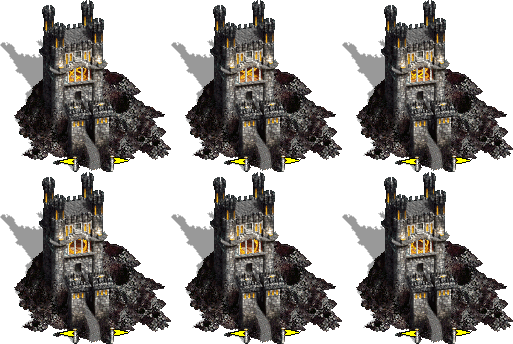
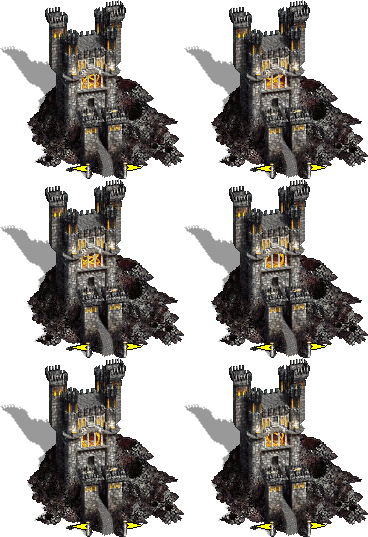
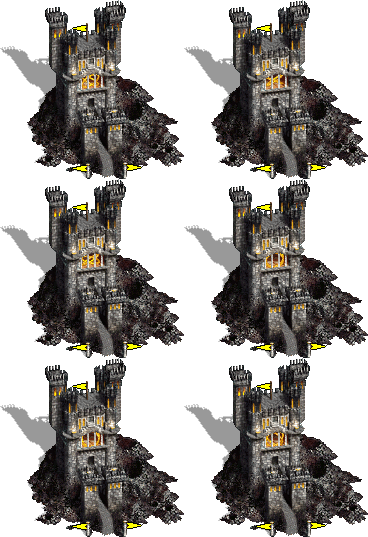
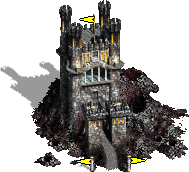
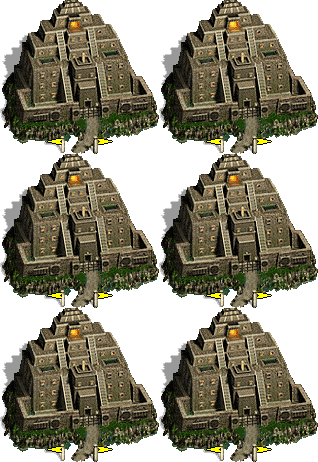
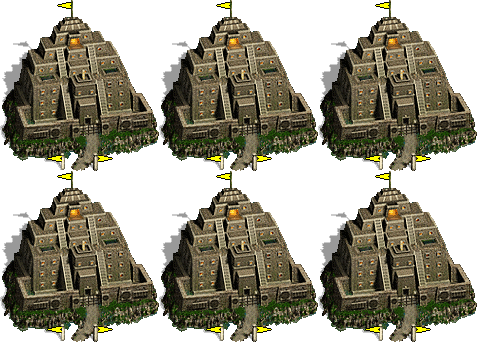
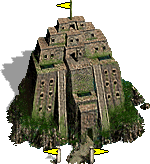
In The Shadow of Death there are just three visual appearances of a town: Village, Fort, and Capitol (as a Fort with a flag), though the exact fortification level (Fort/Citadel/Castle) always can be checked by an icon in the Right Click menu (the hall level is only visible for allies).
In Horn of the Abyss, the level of a town's fortifications is visually represented accurately.